Key Takeaways
- Urban trees in the United States remove 822,000 tonnes of air pollution a year — a service valued at $5.4 billion.
- The National Park Service credits trees with three distinct air quality effects, cooling the air, cutting building energy demand, and directly removing pollutants.
- One large tree can provide a day's supply of oxygen for up to four people, according to the US Forest Service.
- US urban and community areas are losing about 36 million trees a year, while 44 percent of U.S. residents live in a county with a failing grade for ozone or particle pollution.
The haze that settles over a city on a hot summer afternoon is largely fine particle pollution. Particulates measuring 2.5 micrometers and smaller cause the air to appear hazy, and because they can travel deep into the respiratory tract, there are links between long-term exposure to poor air quality and heart attacks, chronic bronchitis, reduced lung function, and lung cancer, according to the New York State Department of Health. Roughly 152 million people in the United States live in a county that earned a failing grade for ozone or particle pollution in the American Lung Association's 2026 State of the Air report.
Trees take a measurable share of that pollution out of circulation. In 2006, modeling by David Nowak, Daniel Crane, and Jack Stevens put annual removal by US urban trees at 711,000 metric tons — a service worth an estimated $3.8 billion — and that number has since been revised upward. Nowak's 2023 assessment for the US Forest Service puts urban removal at 822,000 tonnes a year valued at $5.4 billion, and finds that trees and forests across the conterminous United States removed 22.4 million tonnes of air pollution, avoiding more than 850 incidences of human mortality, 670,000 incidences of acute respiratory symptoms, 430,000 incidences of asthma exacerbation, and 200,000 school loss days, with health effects valued at $8.5 billion.
"The magnitude of the health effects — 850 lives and 670,000 respiratory symptoms — I didn't know what to expect, so it was interesting if not surprising," Nowak, a project leader for the USDA Forest Service, told The Nation's Health. "In terms of public health, I hope this research advances the dialogue on how we design cities to improve air quality and therefore human health using vegetation."
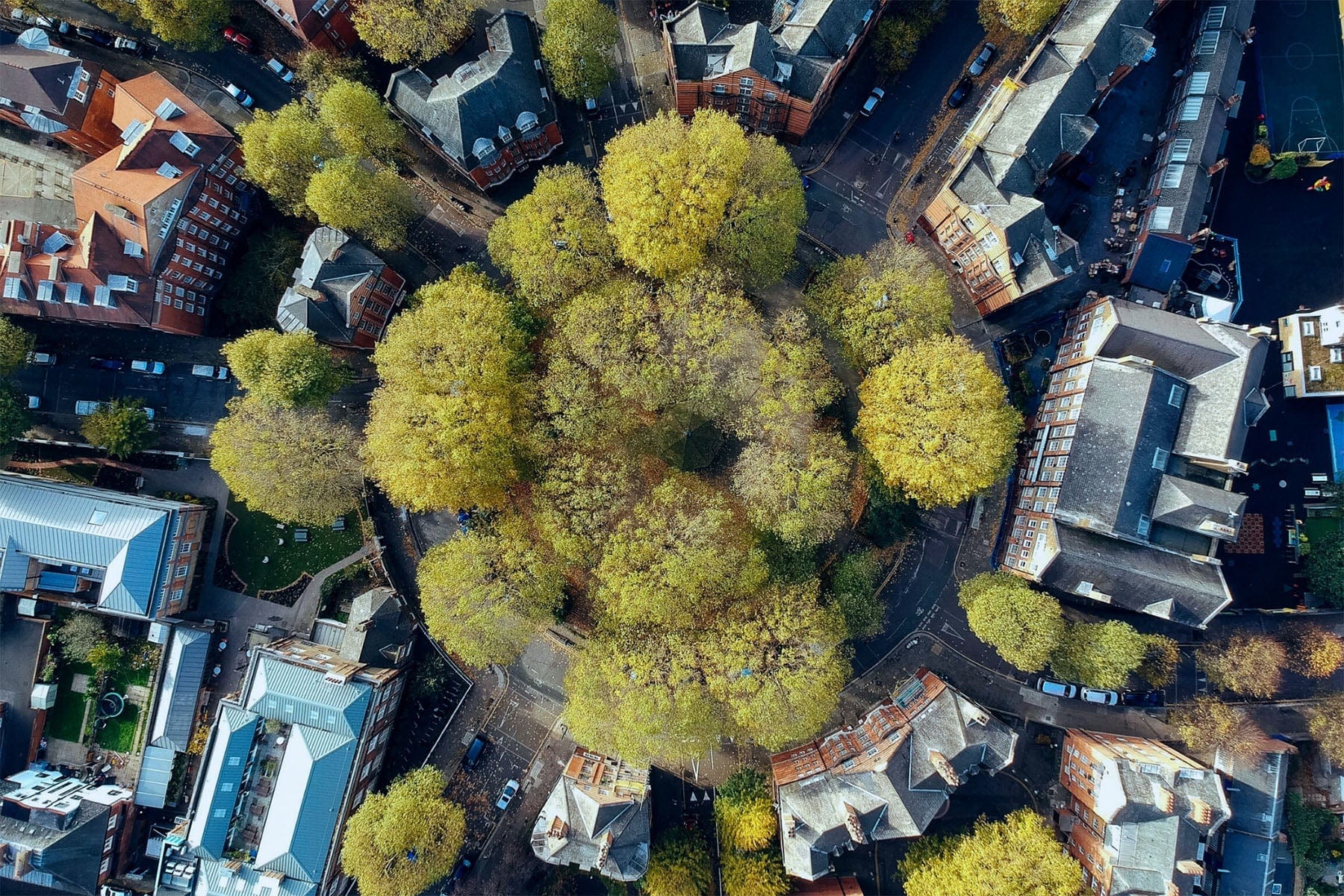
How do trees clean the air?
There are three ways a tree improves the air around it. The first is temperature. Shade and evapotranspiration lower air temperatures, which slows the reactions that produce ground-level ozone (a dynamic covered in our look at the urban heat island effect). The second is energy. A canopy shading a building reduces demand for cooling, and lower demand means fewer emissions from the power plants meeting it. The third is direct removal, the mechanism most people picture when discussing trees and air quality.
That removal works two ways depending on whether the pollutant is a gas or a particle. Gaseous pollutants enter through stomata, the pores on the underside of a leaf, and once inside they diffuse into intercellular spaces and react with inner-leaf surfaces, permanently converting compounds including sulfur dioxide and nitrogen dioxide. Particulate matter is caught rather than absorbed; fine particles cling to leaves and stems instead of floating about in the air, and the arrangement is temporary, since rain washes them into soil or stormwater and wind can lift them back into the atmosphere.
Leaves take in carbon dioxide and water and use solar energy to build sugars, releasing oxygen as a byproduct of photosynthesis. One large tree can provide a day's supply of oxygen for up to four people, according to the USDA.
The pollutants trees remove
Nitrogen dioxide comes largely from vehicles and combustion, and breathing high concentrations of it can irritate airways in the human respiratory system, the Environmental Protection Agency says, aggravating asthma in the short term and potentially contributing to its development over longer exposures. It rarely stays in one form. NO2 and other nitrogen oxides react with other chemicals in the air to form both particulate matter and ozone, and they interact with water, oxygen, and other atmospheric chemicals to form acid rain, which the agency notes harms sensitive ecosystems such as lakes and forests. Sulfur dioxide follows a similar path, through the lungs and into secondary particles.
Ground-level ozone is not emitted directly. It forms when nitrogen oxides and volatile organic compounds from cars, power plants, refineries, and industrial boilers react in the presence of sunlight, which is why it peaks on hot afternoons. People with asthma face the greatest risk from breathing it, and the EPA notes that elevated exposures can harm sensitive vegetation during the growing season, putting the same forests that filter ozone under stress from it.
Breathing air with a high concentration of carbon monoxide reduces the amount of oxygen that can be transported in the blood stream to critical organs like the heart and brain, according to the EPA, and at high indoor concentrations it causes dizziness, confusion, unconsciousness, and death.
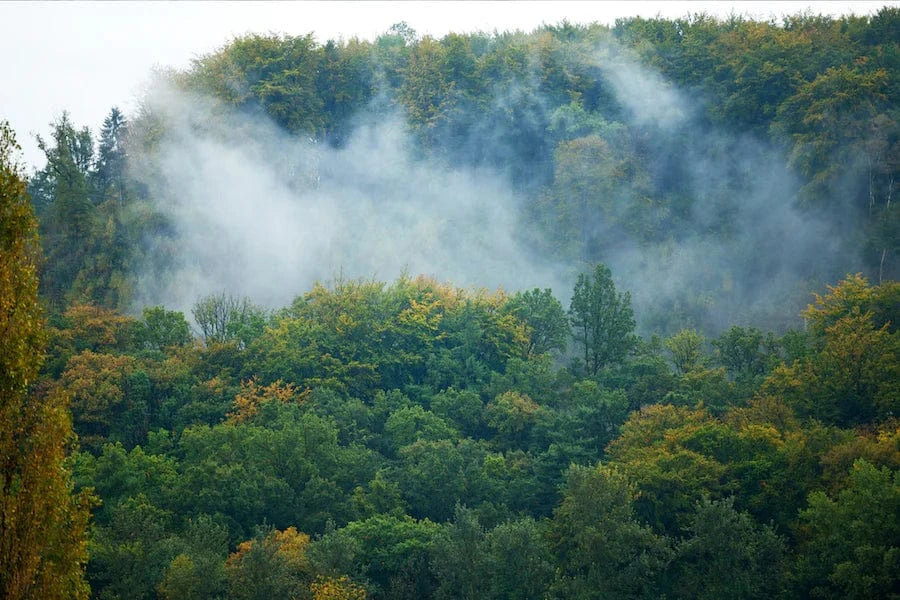
Where the canopy Is thinning
Rural forests account for most of the pollution removed, while urban areas see the greatest health impacts and economic value because more people breathe the air that those trees clean. But cities are steadily losing that canopy. Nowak and Eric Greenfield found that U.S. urban and community areas lost roughly 36 million trees, or about 175,000 acres of tree cover, annually between 2009 and 2014, while impervious surfaces expanded by some 167,000 acres a year. The annual benefits US urban forests deliver through pollution removal, carbon sequestration, and reduced building energy use are estimated at $18 billion.
"Urban forests are an important resource," Nowak told Mongabay. "Urban foresters, planners and decision-makers need to understand trends in urban forests so they can develop and maintain sufficient levels of tree cover — and the accompanying forest benefits — for current and future generations of citizens."
It’s why where trees go matters as much as what type and how many are planted. "If you put trees all over London, the difference would be negligible. But if you strategically put those trees around the source locations, it could reduce the exposure (to nitrous oxides) by more than half," Prashant Kumar, co-director of the Global Centre for Clean Air Research at the University of Surrey, told members of Parliament in December 2023. A tree line along a traffic corridor, a schoolyard, or the edge between housing and an industrial site reaches the people carrying the heaviest exposure burden. Communities of color account for 54.2 percent of the population living in counties with failing air quality grades while making up 42.1 percent of the country.
"Urban trees are one of the simplest ways to mitigate the effects of the climate crisis in frontline communities," Cate Mingoya-LaFortune, chief officer of climate resilience and land use at Groundwork USA, said at the alliance's launch. "We urgently need more trees in heat vulnerable and polluted neighborhoods," Andrea Marpillero-Colomina, sustainable communities program director at GreenLatinos, said.
One Tree Planted plants street trees, park canopy, and schoolyard shade in those neighborhoods through its urban forestry program, and in 2023 joined American Forests, GreenLatinos, and Groundwork USA to launch the Tree Equity Alliance, which works to close the canopy gap in U.S. cities.


