Healthy Forests Make Strong Materials — No Plastic Required: Here's How They Do It

by Jill Ettinger July 23, 2026 8 min read

lush green tropical forest fading into the distance with fog
5 20 50 100
$ USD
lock icon Secure checkout powered by Shopify
Summer of wild - 3x Match

Your first three months, matched!

Join the Grove

Get news, updates, & event Info delivered right to your inbox:

Key Takeaways - Learn About Tree Materials

  1. Tree materials preceded plastic, and they can displace it again. For millennia, humanity relied on trees for everything from shelter to insulation, adhesives, and more.
  2. Unlike plastic, trees regenerate and provide materials for centuries. Cork oaks regenerate their bark for about two centuries, rubber trees yield for 25 to 30 seasons, and carnauba palms produce for up to 50 years without one being felled. Petroleum can only be pulled out of the ground once.
  3. Waiting between harvests is what makes them renewable. Portuguese law allows a cork oak to be stripped only once every nine years. Where no limit is enforced the resource runs down and as wildfire and deforestation increase threats, restoring the land where these trees grow is critical.

Every NASA spacecraft that has landed on Mars got there behind a heat shield made partly of tree bark — a cork and silicone ablator that originated with the Viking landers of the 1970s, according to NASA. Cork remains a critical element of the core, and still line the core stage engine section of the Space Launch System, where four RS-25 engines produce two million pounds of thrust. 

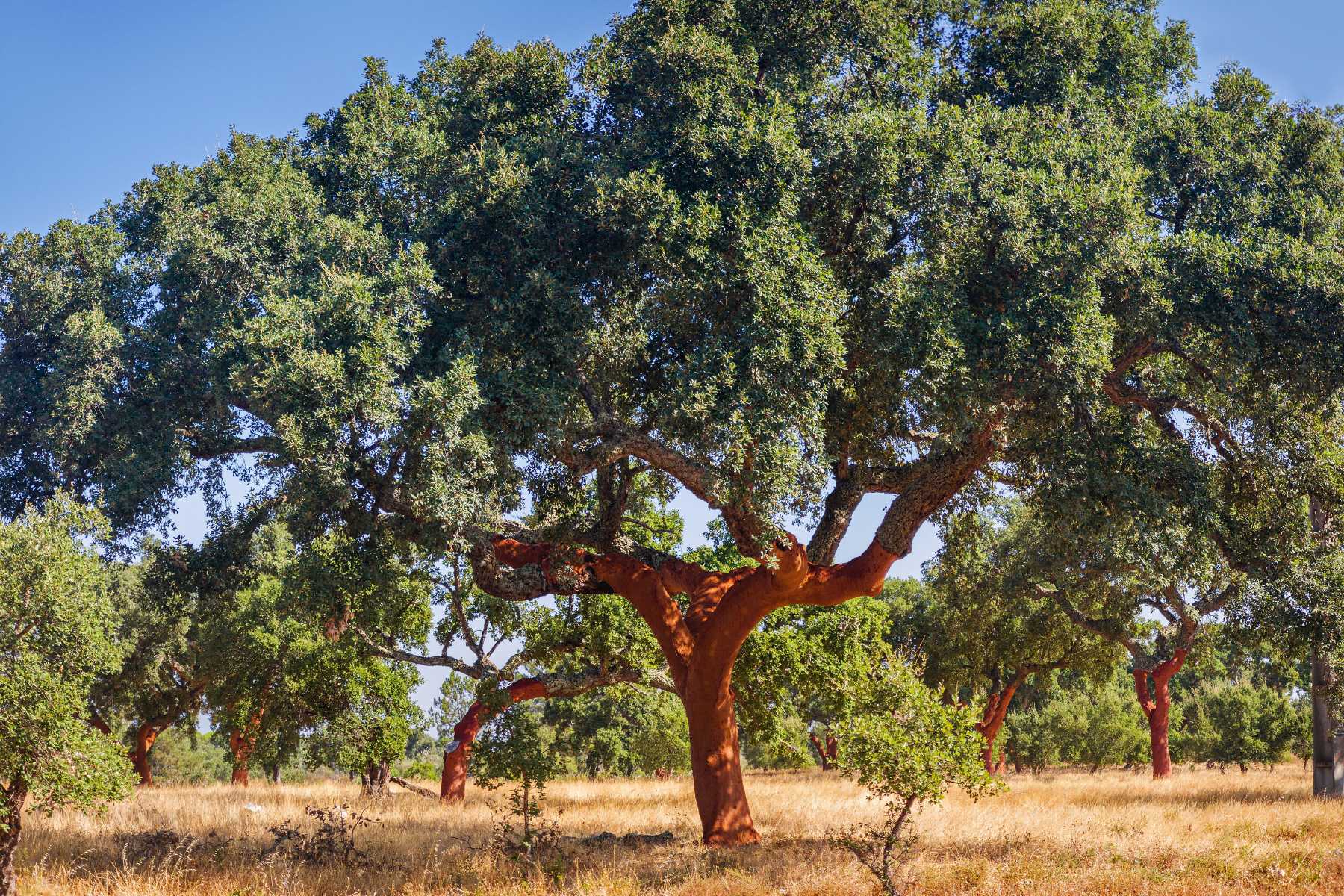
The trees those sheets come from grow primarily in Portugal, and are some of the most protected in the world. A cork oak cannot be stripped until its trunk reaches 70 centimeters around, which takes about 25 years, and Portuguese law forbids returning to the tree to strip cork for nine years after that. Only from the third harvest, around the tree's 43rd birthday, is the cork good enough for a wine bottle (or NASA spacecraft). Over roughly two centuries, a cork tree will support about 15 harvests. 

Harvesting materials from living trees happens on a cycle set to the rate at which the plant can replace what's removed. Cork’s cycle is strictly enforced to nine years but other materials including latex, resin, kapok floss, rattan cane, and carnauba wax come off living plants on the same logic: taking just enough, infrequently enough, so the tree can keep producing more. These tree substances have been used by Indigenous communities for millennia, providing materials for packaging, insulation, adhesives, bedding, and fill for centuries. They provided income sources too as the market demand grew.

Then came plastic. 

How plastic became the preferred material

Petroleum-based materials overtook nearly all of those markets over the course of the 20th century, category by category, on both price and durability. Kapok, which comes from the seeds of a tropical tree, filled life jackets and aviation clothing until, as researchers writing in Plants recorded, "in the 1960s, as a result of the massive production of synthetic fibers, the kapok trade declined substantially." Rosin lost ground the same way — petroleum resins "have gained dominance over natural rosin in some countries," FAO noted, though rosin held its edge on certain chemical properties.

The world now produces roughly 460 million metric tons of plastic a year, a figureThe Organisation for Economic Co-operation and Development  projects could climb 70% by 2040 without stronger policy, and making it accounts for about 5.3% of global greenhouse gas emissions — more than aviation and shipping combined. The pressure runs the other way, too. WWF has warned that plastic stoppers and screwtops taking market share from cork could strip the economic value out of cork oak landscapes, leading to "conversion to other uses, abandonment, degradation, and finally loss." The market for the material is part of what keeps the forest standing.

How forest restoration supports regenerative tree materials

Cork comes out of a landscape the Portuguese call the montado — open cork oak woodland with cattle and crops working the ground underneath, the trees spaced wide enough to let the light through. Young oaks come up readily under an open canopy, but once scrub closes over the ground they nearly stop: 3.6 seedlings per square meter in open woodland against 0.1 in shrubland, researchers reported. Southern Portugal lost 31,312 hectares of montado between 2006 and 2018, mostly to wildfire and to trees dying of disease and pests, a 2026 study in Agroforestry Systems found. A landscape that renewed itself for centuries no longer does, which puts replanting efforts in the routine maintenance column.

This is the work One Tree Planted's projects provide. In Portugal, our work in Leiria has planted 1.3 million native, fire-resilient trees across nearly 1,000 hectares of the Pinhal de Leiria — a 700-year-old coastal pine forest that lost 86% of its area to a single wildfire in October 2017, in 24 hours — and cork oak is among the key species going in, alongside maritime pine and strawberry tree.

In Acre, Brazil, we’re helping to restore 150 hectares of deforested land with 150 families planting 300,000 seedlings in agroforestry systems — trees and crops on the same ground, which is the arrangement nearly every material in the first half of this list comes out of.

Regenerative materials harvested from living trees

These tree materials are taken on a cycle at which the plant is able to replace what's been removed. Cork's nine years is the most enforced example and even with restrictions, there is enough to go around without the need for destroying the entire tree or turning to plastic alternatives. 

Cork

Cork is the bark of Quercus suber, the cork oak, which grows across the western Mediterranean — Portugal produces 46% of the world's supply and Spain another 33%, with Morocco, Algeria, Tunisia, Italy, and France accounting for most of the rest. The harvesting process is a light draw on the tree. The carbon in stripped cork comes to "less than 1.5% of net primary production on a yearly basis," researchers measuring cork oak carbon and water fluxes reported in Forest Ecology and Management in 2021 — the tree keeps almost everything it makes. That same study found stripping in a drought year cut the woodland's summer carbon uptake by about a third, and recommended leaving stressed trees alone, which is the nine-year rule's logic applied to weather instead of time. It replaces foam and plastic in flooring, insulation, and footwear soles, alongside the heat shield used by NASA.

Natural rubber

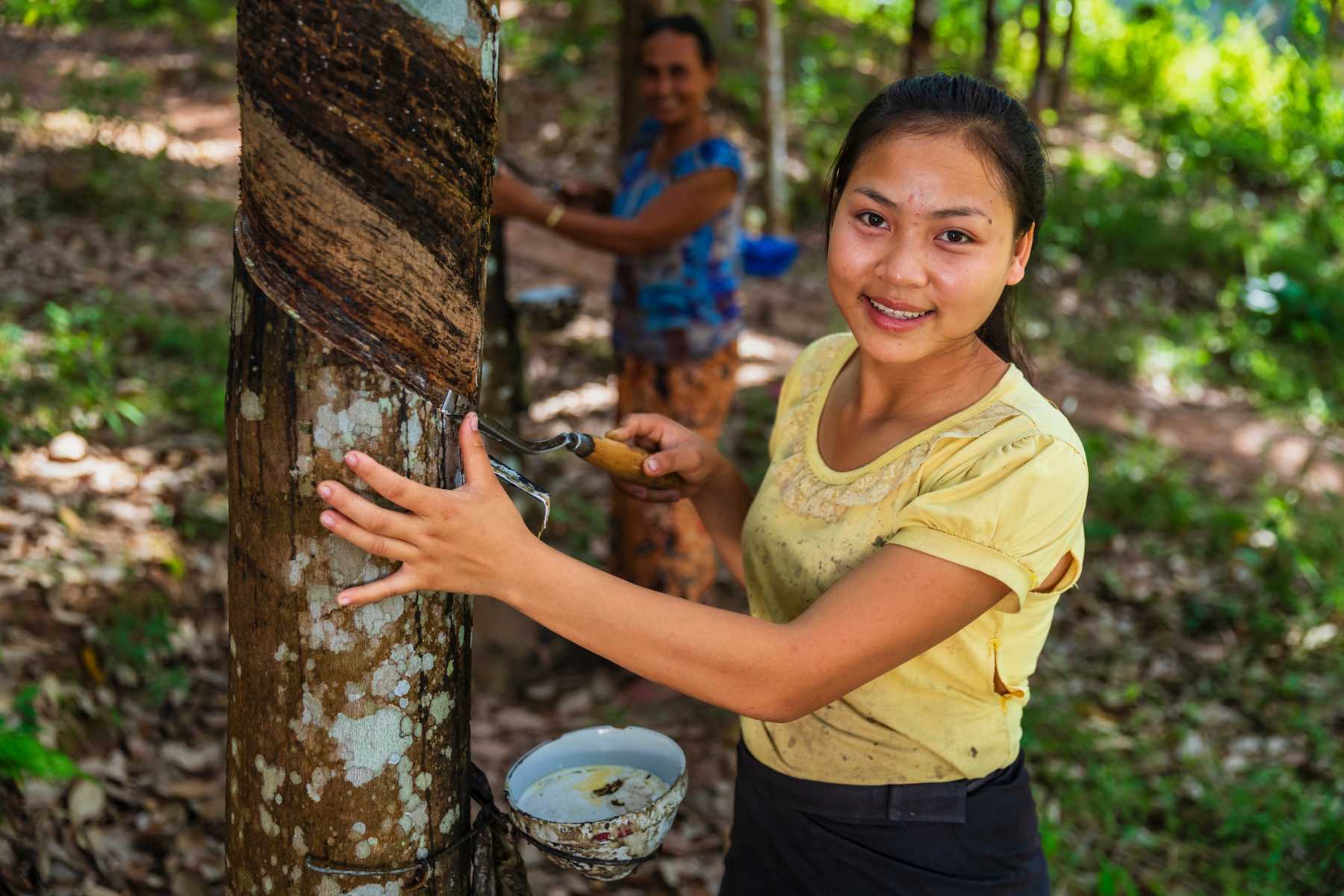
Natural rubber is latex tapped from Hevea brasiliensis, a tree native to the Amazon and now grown mostly in Southeast Asia and, increasingly, West Africa; Thailand, Indonesia, Côte d'Ivoire, and Vietnam are the four largest producers. A tapper cuts a shallow spiral into the bark with a knife shaped to open the latex canals "without damaging the cambium," as FAO describes it, and the tree is left to heal between cuts. Tapping begins in the tree's fifth to seventh year and continues for another 25 to 30 before yields fall away. Roughly 85% of the world's supply comes from about 6 million smallholders, according to a Koltiva analysis. Grown as layered agroforestry rather than cleared monoculture, it is "well recognised for its value in conserving biodiversity," per World Agroforestry.

Pine resin and tall oil

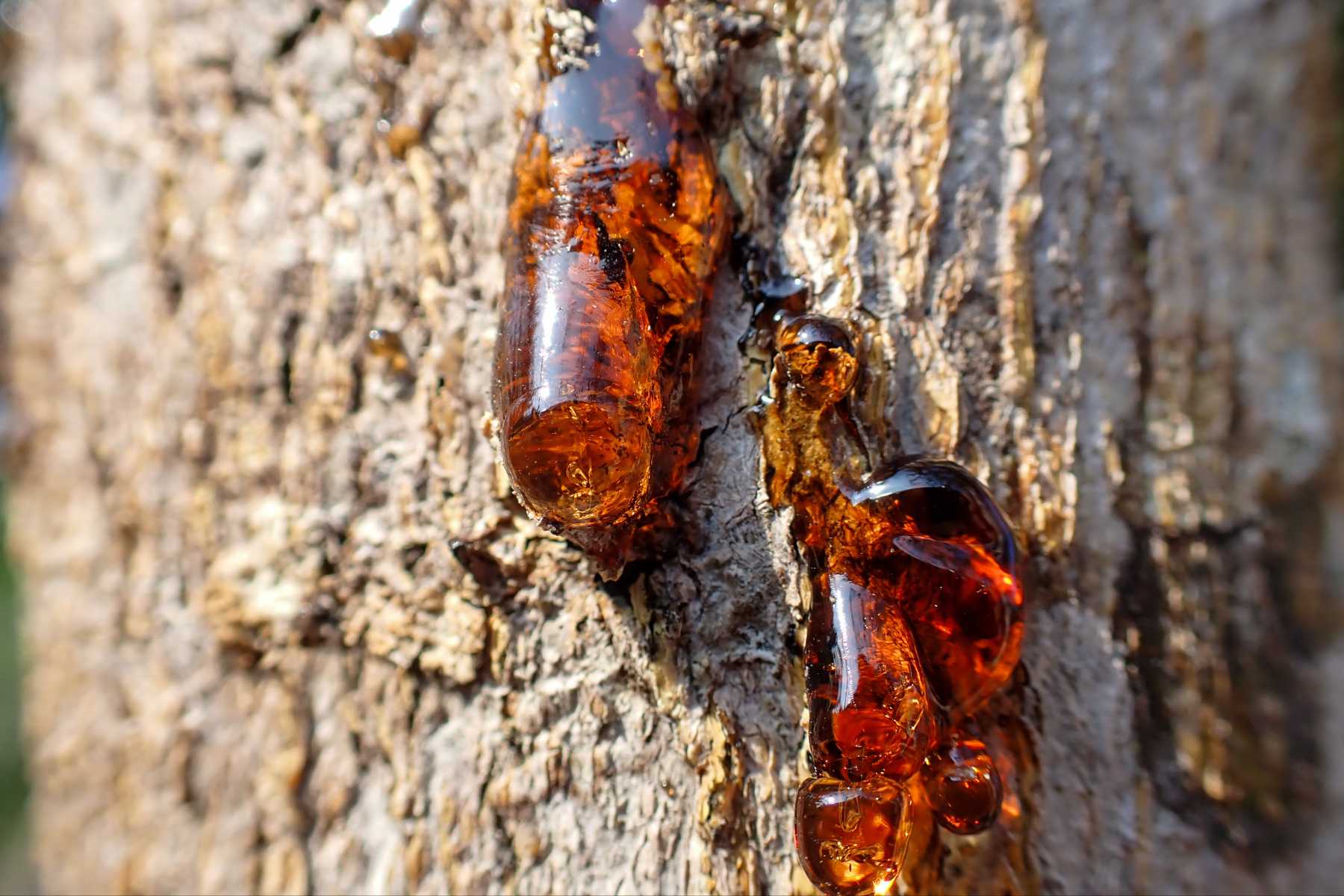
Resin is tapped from living pines — Brazil's slash pine plantations alone yield more than 150,000 tonnes a year — or recovered downstream as a co-product of kraft pulping. Refined into rosin, it becomes the backbone of adhesives, printing inks, rubber compounds, and surface coatings, the applications where petroleum resins compete directly, and the flux in NASA's flight electronics. A tapped tree can be worked for years, though the cut is a wound and heavy cycles slow growth, so cadence matters here the way the nine-year rule matters for cork. A 2023 paper in Biology found tapping delivered a considerable annual increment in carbon stocks.

Kapok

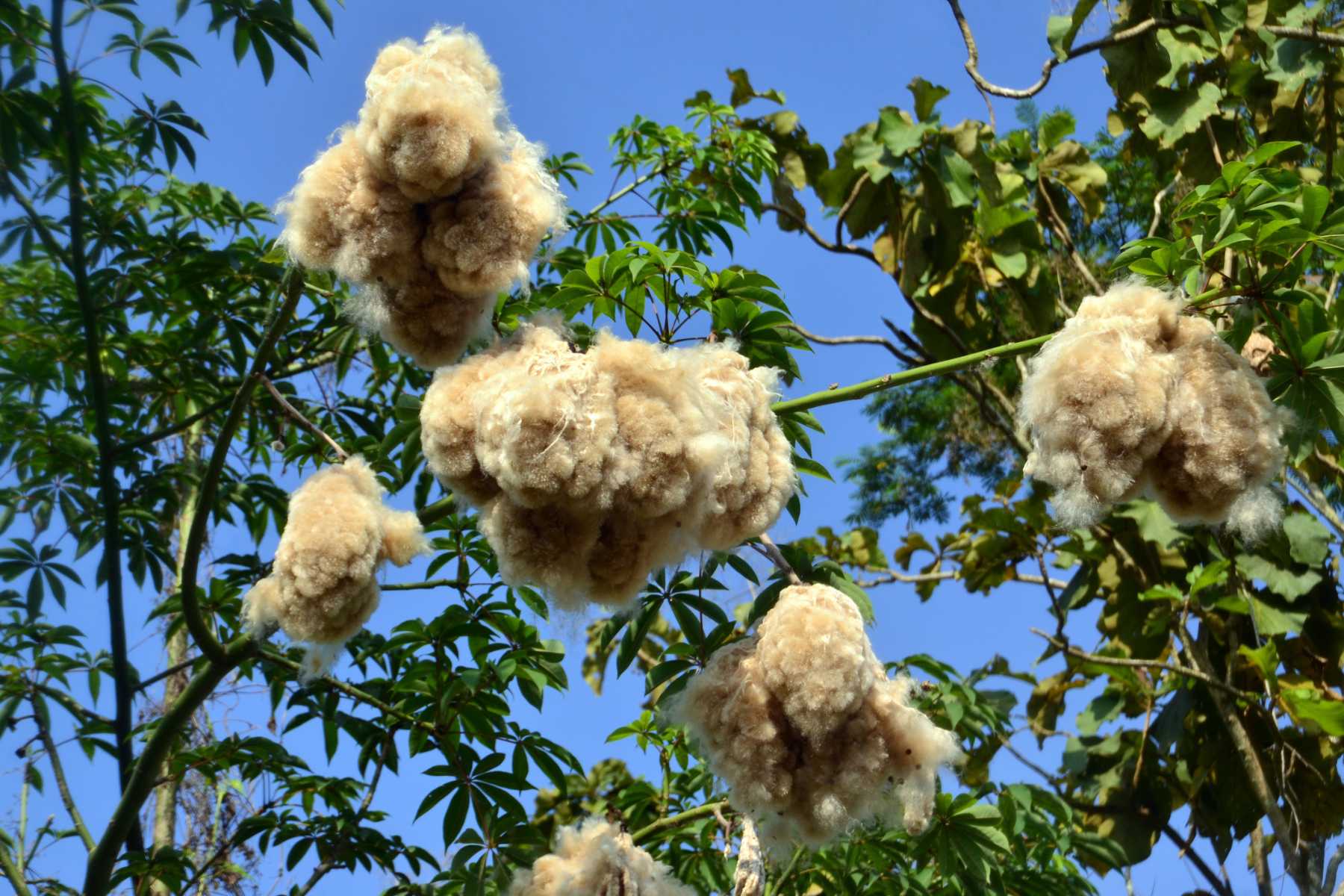
Kapok is the floss inside the seed pods of Ceiba pentandra, a buttressed giant native to tropical America and now grown mostly in Indonesia and Thailand. Harvesters climb the tree or cut the pods down with a hooked bamboo pole, and it keeps bearing — from its third or fourth year to its sixtieth or beyond. The fiber is 77% hollow, eight times lighter than cotton, and outperformed polypropylene against spilled oil in a 2007 Chemosphere study.

Rattan

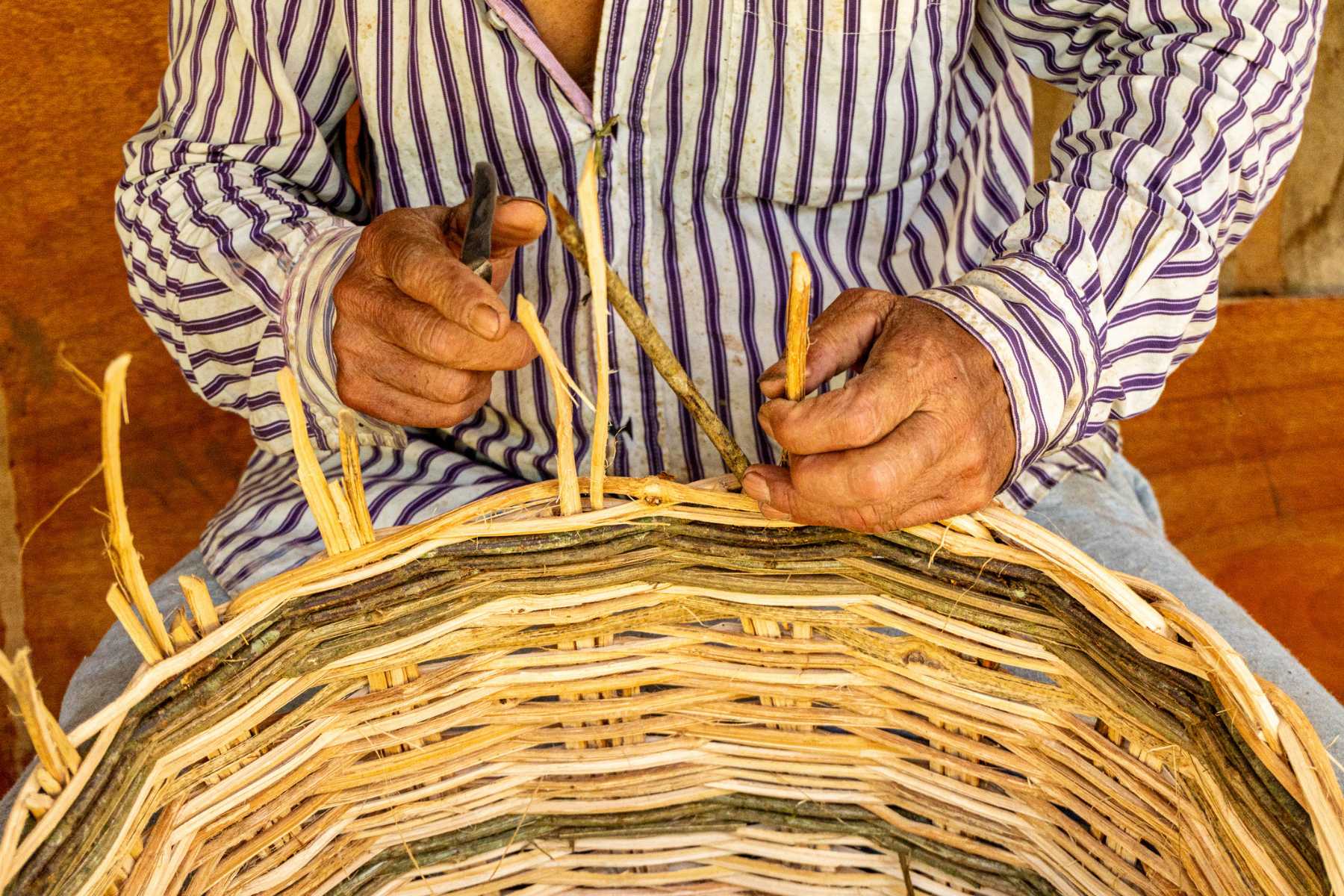
Rattan is the cane of climbing palms — roughly 600 species threading up through the canopy of the old-world tropics, gathered overwhelmingly from wild forest rather than plantation, with Indonesia supplying 85 to 90% of world trade. Cut a clustering species and the plant sends up new suckers to replace what was taken, which is why the cane can be harvested indefinitely. FAO calls it "a high value, high yielding product that relies on the forest milieu for its survival."

Carnauba wax

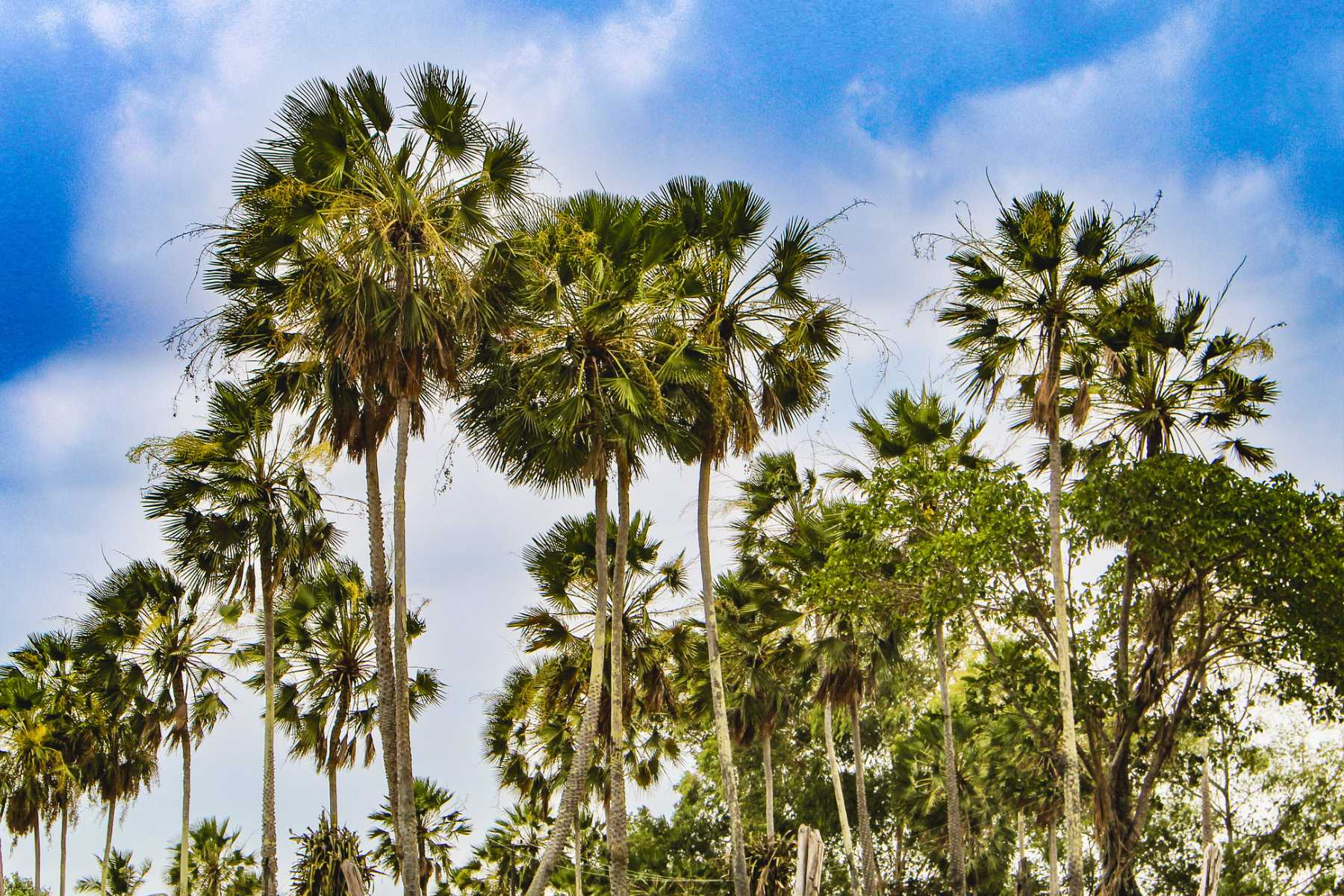
Carnauba is the wax that coats the leaves of Copernicia prunifera, a palm of Brazil's semi-arid Northeast — Piauí, Ceará, Rio Grande do Norte — where the coating keeps the plant from losing water in the dry season. Harvesters cut the leaves with scythes lashed to long poles between August and December, and Repórter Brasil reports a palm can be worked continuously for up to 50 years without a single tree being felled. The hardest natural wax, it is under research as a bio-based coating to replace plastic packaging. The industry has been scrutinized over human rights and labor violations, however, something the Initiative for Responsible Carnauba is working to address.

Felled-tree sourcing and the management behind it

Not all tree materials can leave the tree intact. Lyocell and viscose are both fabrics made from wood. Trees are pulped, the cellulose is dissolved into a liquid, and the liquid is spun back into fiber. The wood behind these materials is mostly plantation eucalyptus and acacia from Brazil, South Africa, and Indonesia, alongside beech, spruce, and birch from temperate forests. 

Making it means felling trees: more than 300 million a year go into fabric — and from some of the most vital forest ecosystems in the world. The Forest Stewardship Council's Principles and Criteria oblige a certified operation to maintain riparian zones, protect representative samples of native ecosystems, regenerate vegetation cover in a timely fashion, use native species "unless there is clear and convincing justification for using others," and plant no genetically modified trees.

FSC Controlled Wood carries "a low risk of originating from unacceptable sources" — not illegally harvested, not from converted or threatened high-conservation forest, not tied to rights violations, not genetically modified. "The focus is on assessing and controlling sourcing risks rather than certifying the forest manager's overall performance against a forest management standard," Tallulah Chapman, communications manager at FSC UK, told One Tree Planted via email, describing it as "a step towards full FSC Forest Management certification." It screens out the worst sources rather than certifying good management. 

Still, 35% of global production is at known risk of ancient and endangered forest sourcing. Where a plantation goes matters more than whether or not it carries a certificate. Put one where natural forest was standing and virtually all of the plant species growing there are lost; but put the same plantation on land already stripped and degraded, and, while not a substitute for the benefits of a biodiverse forest, it can help prevent further deforestation and accelerate basic land stabilization.

For the consumer, an FSC label "provides evidence that the forest-based materials used to produce it have been responsibly sourced," Chapman said. Two labels do most of the work: one reading "FSC 100%," meaning every fiber came from a certified forest, and one reading "FSC Mix," meaning a blend of certified, recycled, and controlled sources. Certified companies, textile makers included, also have to meet core labor standards barring child and forced labor and protecting the right to organize. "What the FSC label won't tell you is how a garment has been processed — issues such as water, energy and chemical use (except at a forest level) are not covered by FSC certification," she added. One tip: check the product type printed in the label, since a "paper" designation likely refers to the hangtag while "viscose" refers to the garment itself.

Lyocell

Between lyocell and viscose, lyocell is the cleaner of the two processes. Pulp is dissolved in a solvent and spun into fiber inside a closed loop that recovers more than 99.8% of that solvent and returns it to the line, according to Lenzing, the Austrian producer that sources its eucalyptus, beech, spruce, and birch from FSC- or PEFC-certified or controlled forests. A 2023 study in PLOS ONE found regenerated cellulose biodegraded completely in seawater in about 35 days, while polylactic acid, sold as biodegradable, remained intact after 428. In blends, the cellulose goes and the plastic stays.

Viscose

Viscose is the original route from wood to fabric and still the largest, at 6.7 of the 8.4 million tonnes of manmade cellulosic fiber produced in 2024. It is also the fastest-improving: a 2025 report found nearly 70% of producers earning a green rating against zero in 2016. 

5 20 50 100
$ USD
lock icon Secure checkout powered by Shopify
Summer of wild - 3x Match

Your first three months, matched!

Join the Grove

Get news, updates, & event Info delivered right to your inbox:
Jill Ettinger
Jill Ettinger

Jill Ettinger is a writer and editor covering the intersection of culture and sustainability. Her reporting connects our everyday choices to the environmental and social-justice stories shaping them, from the products we put in our carts to the communities a changing climate touches most. She is based in Los Angeles.